Music’s meaning is not universal.
It doesn’t communicate the same message or even emotion to every person in the world.
In 2022, Margulis et al. published an article in Music Theory Online (MTO) called Intersubjectivity and Shared Dynamic Structure in Narrative Imaginings to Music.
Narrative imaginings are one of my favorite things to hear about from other people. They are the stories that people create in their minds when listening to music.
A common one is that when people hear most classical music nowadays, they tend to imagine a “fancy party.”
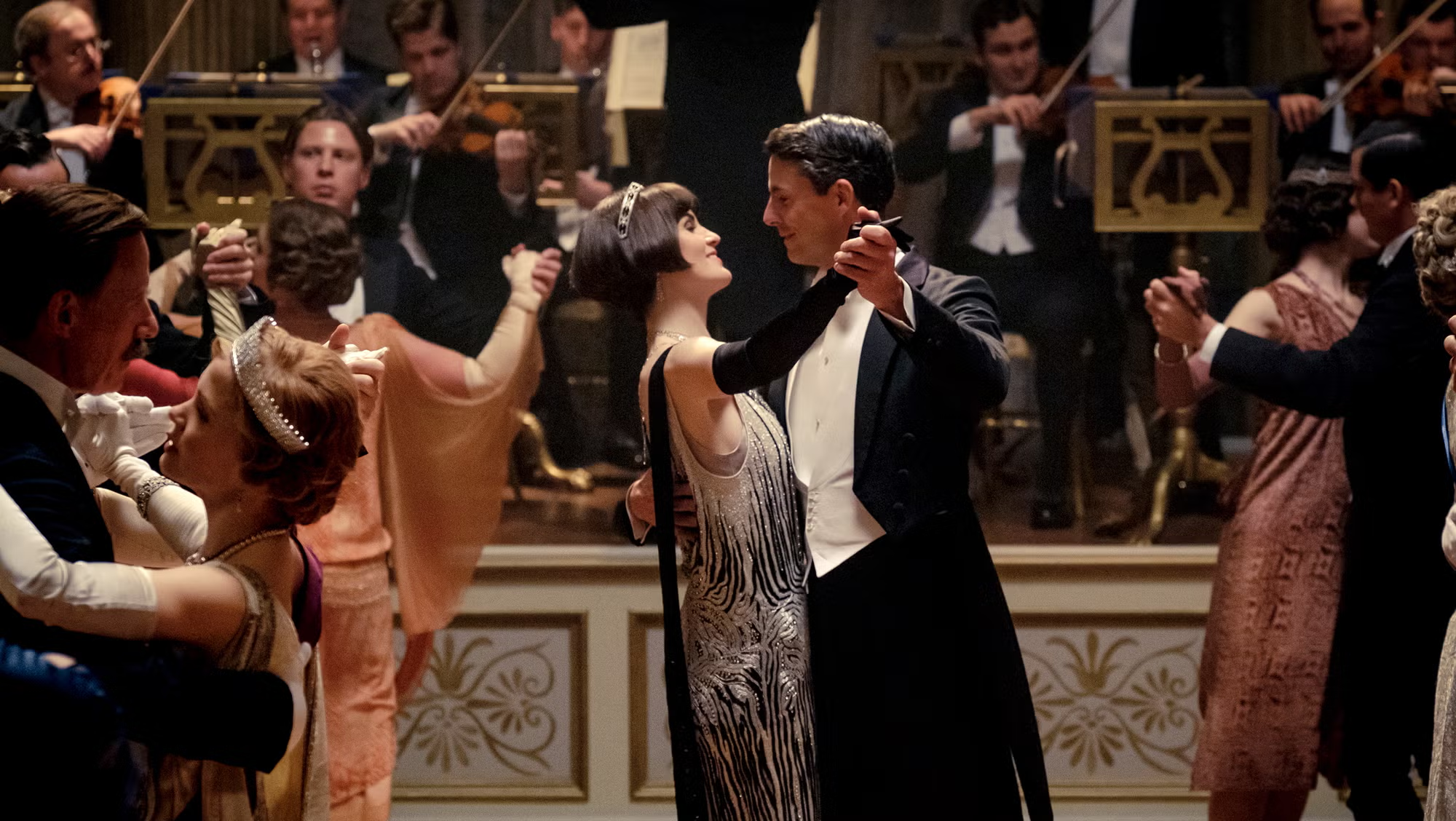
Margulis et al. were interested in these types of stories that people come up with in their heads when listening to instrumental music, and if there were any patterns or similarities between stories from different people and different cultures.
To look into this, the researchers gathered participants from multiple geographic locations: Arkansas and Michigan in the US (who had tons of exposure to Western media) and an isolated Dong village in a rural part of China, called Dimen where participants had little to no exposure to Western media.
They then had these participants listen to excerpts of music that would have been familiar to at least one of these two cultural groups. And then the participants wrote down what they imagined in a free-response form.
For example, the researchers played part of Webern’s String Quartet op. 28, which sounds like this:
Interestingly they found that people from similar cultural groups told similar stories. The US groups told stories about horror, murder, and paranoia.
Some quotes were:
I imagined a murderer in a suburban house trying to find the inhabitant of the house, while she was trying to hide from the murderer.
I imagined someone in a horror movie when they sense that someone is in there [sic] house with them. There is a woman who hears something from another room in the house, or sees a shadow in the corner of her eye, and she goes to look through the house for it.
The researchers explain that it seems the US participants seemed to focus on the atonality in this musical excerpt, which you’d commonly also hear in horror movie scores.
The participants from Dimen, on the other hand, seemed less focused on atonality but instead on the staccato articulations and big jumps from high to low, which for them, mapped onto scenes of playing with friends in childhood:
I play with my favorite friends at home, and we go into the mountains, very very happily.
I see kids in roller skates skating around happily.
In a follow-up study, the researchers also explored whether these associations were recognizable to other people from the same culture.
The new sets of participants (from the same places) performed a matching task, where they listened to the same musical excerpts but did not write what they imagined while listening. Instead, they were tasked with identifying which of two stories came from a previous participant. So they were given a fake story and a story by someone from the first study.
When the participant performing the matching task was presented with a story written by a participant from the same culture as them, they did really well, but they did significantly worse when the stories were written by someone from a different culture.
After this, Margulis’s lab performed an analysis called “term frequency-inverse document frequency (TF-IDF)” which basically means they looked at how frequently certain words appeared in narratives for each musical excerpt. Then they assigned a numerical score to represent that frequency.
They charted the scores in this figure to show in physical, 2-d space, the similarity between each group:

On the lower left, the Michigan and Arkansas groups were so similar that they are basically one big interwoven blob, and Dimen is far away on the top right.
The article also goes into whether these narrative imaginings happen in real-time while listening and how narrative events sync up with music-structural events, but the main takeaway I wanted to share in this post is that musical meaning of a piece of music (or at least its interpretation) relies heavily on culture, meaning that musical meaning is not absolute or universal.
It depends on your culture.
That’s a big reason why it’s so important that there are many theories of music.
Music theory, as a field, tries to understand how people interact with and understand music. If different groups of people hear the same piece of music differently, then we need different theories that explain each of those ways of hearing.
It’s not just, “we need a different theory for every style of music” we also need a different theory for every possible way people hear every style of music.
That’s a lot theories.
Some larger theories or like areas in the field do include these types of smaller sub-theories within them, but there isn’t a single book out there or area in the field that covers every single way of hearing, so it’s important to keep asking everyone what they’re hearing and experiencing.
This is why I keep saying that music theory can be a practice of empathy. Learning about other ways of hearing—by learning about a theory of music—can let you step into that way of hearing and appreciate another person’s point of view.
And it’ll probably influence the way you hear music too.